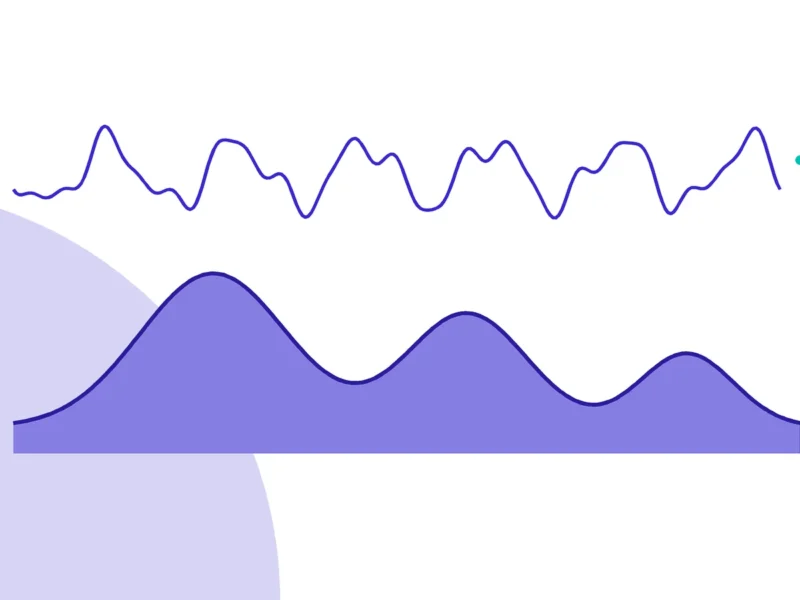











When you sing a note, your ear receives a single clear pitch. But what your voice actually produces isn’t one frequency: it’s an entire tower of frequencies stacked on top of each other. We call those layers harmonics, and they’re your sound’s fingerprint.
CajaConcepto — A note never travels alone
When you sing an A3 (220 Hz), your voice doesn’t just produce those 220 Hz: it also produces 440, 660, 880 Hz… exact multiples of the original note. These are harmonics H1 (the fundamental), H2, H3, and so on. The first is what your ear identifies as “the note”; all the rest give the sound its body, brightness, and presence.
What harmonics tell you about your voice
How energy is distributed among those harmonics isn’t random: it reflects how your vocal folds are vibrating in that instant. A soft, breathy closure leaves the first harmonic strongly dominant and dampens the higher harmonics: the sound comes out warm, intimate, a bit “airy”. A very tight closure, on the other hand, reinforces the higher harmonics and the sound turns more metallic, more cutting. At the balance point there’s a clear fundamental accompanied by well-distributed harmonics — neither muted nor blown out. This is general voice acoustics, common to any analysis system.
Brightness lives in the high harmonics
The harmonics above roughly 2 kHz are what we usually call a voice’s “brightness” or “projection”: the quality that lets a sound cut through a room or feel present even in a modest recording. It’s not that those frequencies are “better” — they’re simply the ones the human ear detects most easily, which is why a voice with energy up there is perceived as more alive.
Three colors, one note
You can sing the same note, with the same amount of air, and sound three completely different ways depending on how you distribute energy among the harmonics. A breathy sound, a tense one, and a relaxed one aren’t “different notes”: they’re the same fundamental with three different harmonic distributions. Learning to feel that difference is learning to hear your own timbre from the inside.
It’s not just about singing louder
A distribution with more high harmonics isn’t automatically “better”: every style, every phrase, every moment in a song calls for a different distribution. A lullaby calls for a soft distribution, with the fundamental dominating and few high harmonics; a chorus that needs to cut through a full band calls for the opposite. Learning to consciously shift that distribution, instead of just “singing louder” when you need presence, is one of the differences between a voice that pushes and a voice that projects efficiently.
Why this isn’t seen, it’s heard
Unlike pitch, which any ear recognizes instantly, the distribution of harmonics is harder to name while you’re singing: we notice it as a sensation (“that sounded more metallic today”, “that sounded more muted today”) before we notice it as a concept. That’s why many singers find it easier to understand their own timbre by seeing a visual representation of the sound, like a spectrogram, than by only listening to themselves, where the inner ear always adds nuances an outside listener doesn’t perceive the same way.
CajaPruébalo — A minute with your own voice
Pick a comfortable note. First, whisper-sing it with lots of air, very soft. Then, tighten it, push it to a tense extreme. Finally, find it relaxed, somewhere in between. It’s the same note all three times: what changes is the “color”, and that color is the distribution of harmonics shifting.
Glosario
- Fundamental frequency — the lowest frequency of a note, the one we identify as “the pitch” we’re singing.
- Harmonic — each exact multiple of the fundamental frequency (H1, H2, H3…) sounding alongside it.
- Spectrum — the set of all frequencies present in a sound and their relative intensity.
- Brightness — the sense of projection and presence contributed by the higher harmonics.
Keep reading
Want to see how the harmonics of your own voice are distributed, session after session? Analyze your voice →