

















VoiceScan Lab
Your voice,
turned into
a map.

We track how your voice behaves across your entire range and hand it back to you as a clear report: where you stand, what's holding you back, and where to go next.

↓
FROM EAR TO DATA

For centuries, singing has been judged by ear.

For centuries, singing has been judged by ear. VoiceScan turns that expert listening into objective, repeatable, comparable measurements — without losing the singer's own language.

4Vocal zones
1Guided recording, just a few minutes
4Mechanisms observed
∞Comparisons over time
Who it's for

One report, three ways to use it.

Singer recording in front of a microphone
Illustrative example
Low chest
Balanced
High chest
Focus area
Middle voice
Balanced
Upper-middle
Needs attention

Your voice, by zone — in your language, no percentages or parameters.

Singers

Stop singing blind

You notice that somewhere in your range something shifts — the voice tightens, slips, or loses brightness — but you can't quite pin down where or why. VoiceScan records your voice across your whole range and hands it back as a zone-by-zone map: where it flows, where it's holding on, explained in your language, no jargon.

  • See exactly which zone flows and which one tightens, with clear names.
  • Get a report organized by vocal zone, in singer's language.
  • Compare today's voice with next month's and see the progress.
  • Know where to put in the work, instead of guessing.
Singing teacher in a class
Illustrative example
Before
Low ch.High ch.Mid voiceUp. mid
After
Low ch.High ch.Mid voiceUp. mid

Two sessions from the same student: the progress, visible zone by zone.

Teachers and vocal coaches

Teach with data

Your ear already knows what's going on with your student's voice; the hard part is showing it and proving they're improving. VoiceScan turns that expert listening into an objective picture you can bring into class, save, and compare session to session. Your judgment, backed up; their progress, visible.

  • Show your student what you already hear, made visible.
  • Back up your judgment with an objective, repeatable reference.
  • Track progress between sessions, not from memory.
  • Focus the lesson exactly where it's needed.
Recording studio
Illustrative example
Low ch.High ch.Mid voiceUp. mid
Singing voice, full range Sustained note, one point

VoiceScan offers guidance and does not replace the assessment of a healthcare professional.

Speech therapists and phoniatricians

A bridge between the clinic and singing

The singing voice is pushed across its whole range, not just in a single sustained note. VoiceScan brings an acoustic analysis of the singing voice that complements your assessment and makes objective tracking over time easier. A shared language between the clinic and vocal pedagogy.

  • Acoustic analysis of the singing voice across the full range.
  • A shared-language bridge between the clinic and singing.
  • Objective tracking of progress, session by session.
  • Complements your work; never replaces it.
The process

How it works

Recording a vocal scale with a phone

Record

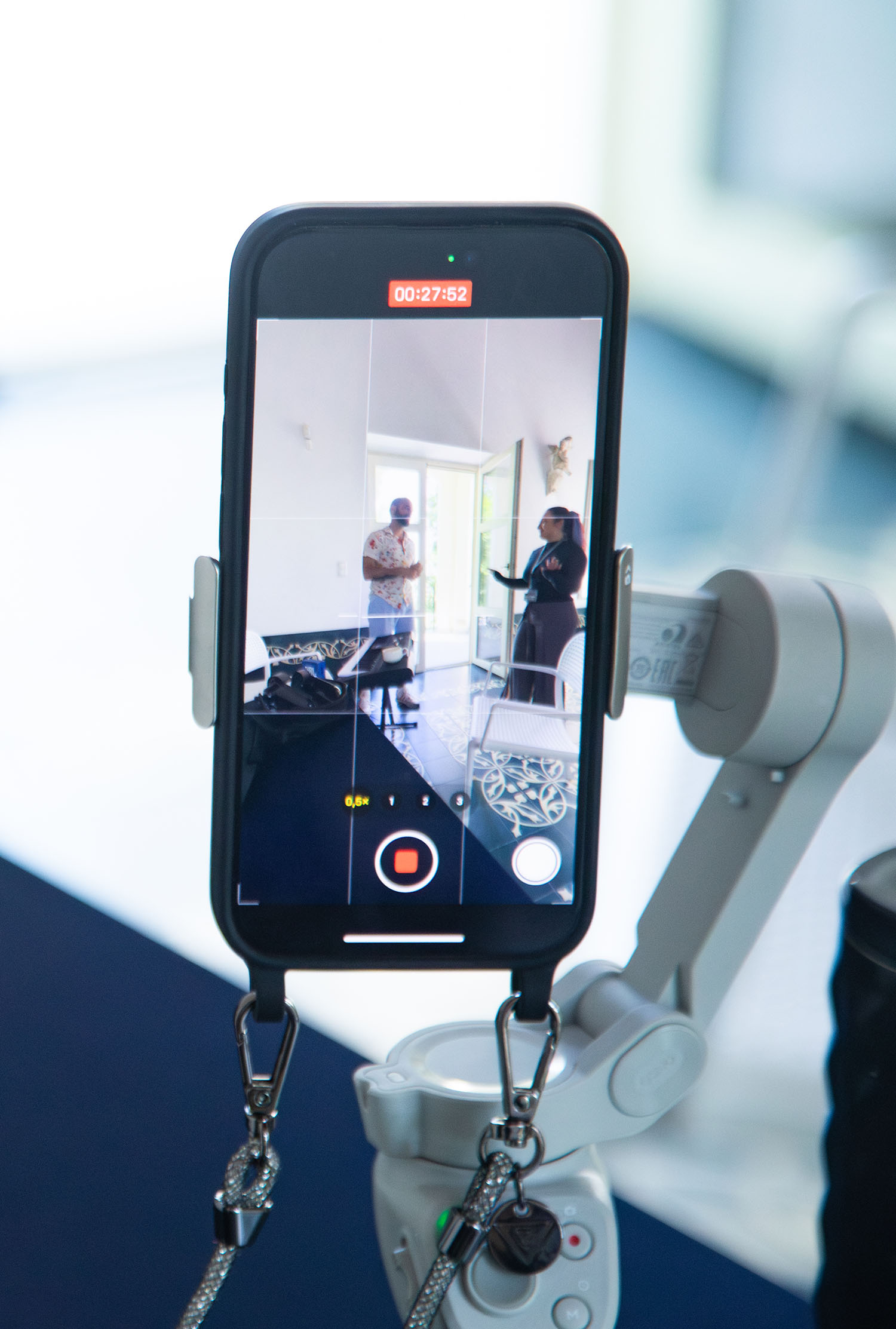
A guided scale across your range: with your iPhone (Android coming soon), or from your computer with a dynamic microphone and an audio interface.

Acoustic analysis of the voice

Analyze

Acoustics and artificial intelligence listen for what the ear can't.

Singer understanding their zone-by-zone report

Understand

A report by vocal zone, in clear language.

Community of voices evolving with VoiceScan

Evolve

Repeat, compare, and watch your progress.

For the first time, a singer can see what their teacher hears.
The 4 vocal zones represented by the VoiceScan Lab anagram
The 4 zones

One map, four zones, a bridge between them.

Picture your voice as a four-storey building: low chest and high chest at the bottom, middle voice in the middle, and upper-middle at the top. Between high chest and middle voice sits the passaggio, the bridge where many voices "break". VoiceScan walks through those four floors and tells you, zone by zone, how your voice is behaving and what you can work on in each one.

Illustrative example Your report by zone

How your voice responded in each zone

For each zone we show you how the three fundamentals behaved: the strength with which your cords come together, the clarity of the sound, and the muscular balance as you go up.

1 2 3 4
5 6 7 8
1st bridge
9 10 11 12
2nd bridge
Your current ceiling 13
14 15 16

Zone 1 · Low chest

Balanced

Zone 2 · High chest

Balanced

Zone 3 · Middle voice

Somewhat tight

Zone 4 · Upper range

Somewhat tight

Zone 1 · Low chest · scales 1-4

Balanced
85/100

“Good control, with a nuance or two.”

What holds it up: a clear, stable sound, with no breaks.

What tempers it: the cord closure falls a bit short as you go up.

Closure strength
A bit tight
Sound clarity
Excellent
Mechanism change
Well balanced
Zone technical sheet

System classification

Stability
Consistency

Extracted parameters

Harmonic spectrum

Resonances

Aperture
Tongue position
Placement
Brightness

Zone 2 · High chest · scales 5-8

Balanced
85/100

“You hold the step up to the second floor well.”

What holds it up: the timbre stays bright as you go up.

What tempers it: toward the end of the zone the air feels a bit loose.

Closure strength
Well set
Sound clarity
Very good
Mechanism change
A bit tight
Zone technical sheet

System classification

Stability
Consistency

Extracted parameters

Harmonic spectrum

Resonances

Aperture
Tongue position
Placement
Brightness

Zone 3 · Middle voice · scales 9-12

Somewhat tight
69/100

“The first bridge asks a bit more of you.”

What holds it up: you reach this zone without losing the color of your voice.

What tempers it: crossing the first bridge, the closure tenses up and the sound tightens.

Closure strength
A bit tense
Sound clarity
Good
Mechanism change
Abrupt
Zone technical sheet

System classification

Stability
Consistency

Extracted parameters

Harmonic spectrum

Resonances

Aperture
Tongue position
Placement
Brightness

Zone 4 · Upper range · scales 13-16

Somewhat tight
43/100

“This is your current ceiling.”

What holds it up: you reach with intention up to scale 13.

What tempers it: the second bridge still asks you to hold the air longer before releasing the sound.

Closure strength
Escapes
Sound clarity
Irregular
Mechanism change
Pending
Zone technical sheet

System classification

Stability
Consistency

Extracted parameters

Harmonic spectrum

Resonances

Aperture
Tongue position
Placement
Brightness
Science with rigor

VoiceScan is undergoing independent scientific validation

With an international panel of singing teachers and academic collaboration.

Learn more
Contact

Have questions or want to analyze your voice?

Tell us about your case and we'll get back to you soon.